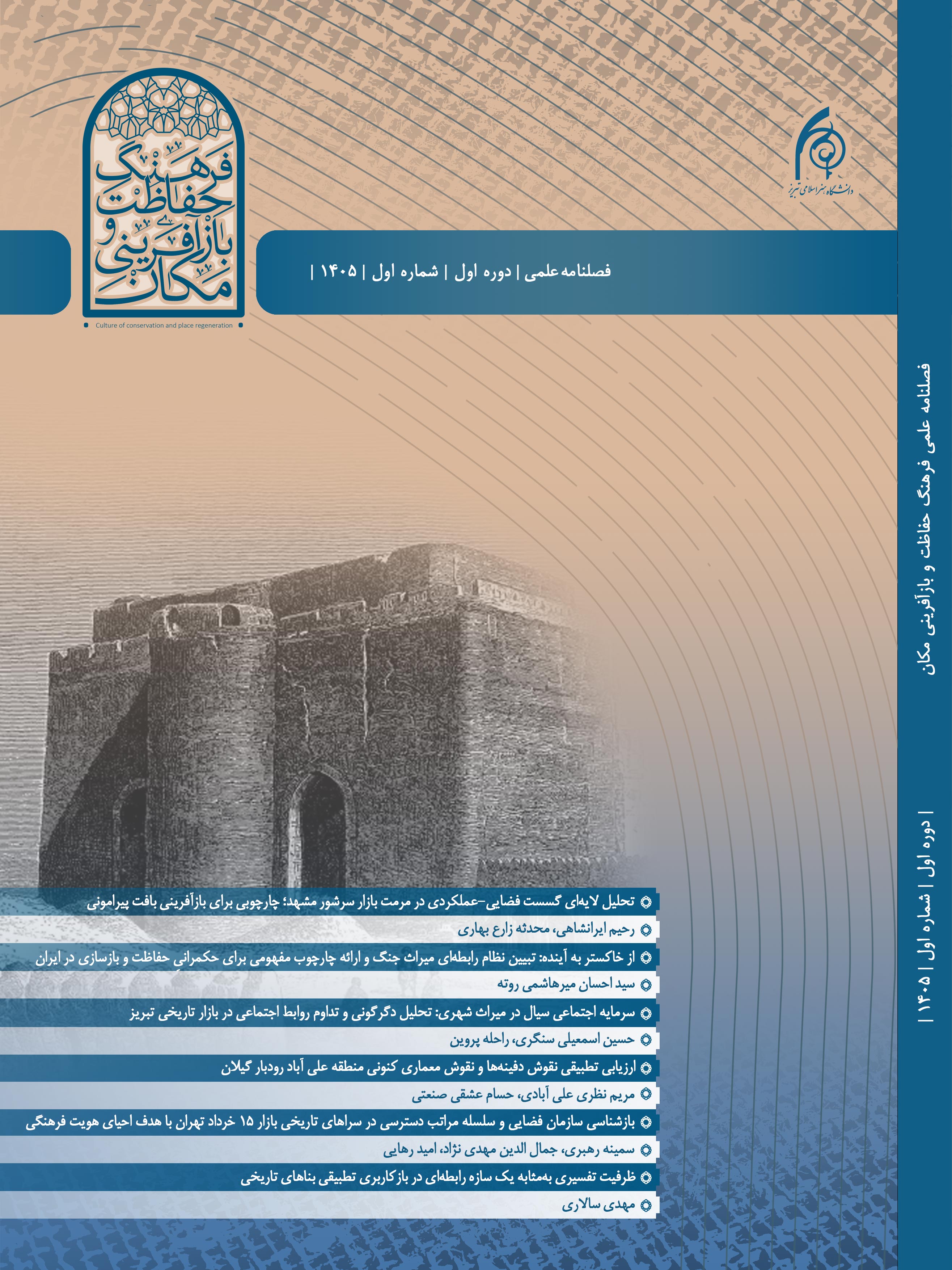
نوع مقاله : مقاله پژوهشی
نویسندگان
1 گروه معماری، دانشکده معماری و هنر، دانشگاه گیلان، رشت، ایران
2 گروه معماری، دانشکده معماری و شهرسازی، دانشگاه بینالمللی امام خمینی (ره)، قزوین، ایران
کلیدواژهها
عنوان مقاله English
نویسندگان English
This study comparatively evaluates documented archaeological motifs, locally referred to as treasure motifs (“Dafineh” motifs), and motifs found in the contemporary architecture of Aliabad, Roudbar, Guilan Province. It aims to assess the formal and semantic correspondence between the two groups and distinguish documented cultural continuities from later folk interpretations. The research employed an analytical–comparative methodology combined with directed qualitative content analysis. Data were collected from three sources: field documentation of 124 architectural motifs in 15 vernacular buildings; semi-structured interviews with 5 local architects, 3 archaeologists, and 2 cultural-heritage specialists selected through snowball sampling; and archival and archaeological records from three sites (Anarak, Arg-e Dasht, and Jour Aliabad). The research comprised six steps: purposive sampling; definition of analytical categories; data collection; coding and classification; inter-coder reliability assessment; and comparative and semiotic analysis. Reliability was assessed on 20% of the coded motifs (34 motifs), independently coded by two coders, yielding 89% agreement and a Cohen’s kappa of 0.84. The findings indicate that the examined archaeological assemblage contains only a limited range of simple decorative forms. None of the motifs commonly identified locally as treasure motifs—such as spirals, crosses, concentric circles, regular zigzags, or zoomorphic figures—was identified in the examined ceramics. Thus, the evidence does not establish a direct archaeological correspondence between contemporary architectural motifs and locally attributed treasure motifs. Architectural motifs are predominantly described as decorative and identity-related, while interviews provide contextual evidence for interpreting local meanings and oral beliefs. The results support only limited, primarily formal correspondence at the level of broad visual categories. A numerical percentage of correspondence or statistical significance cannot be established from the available frequency data. Similarities should therefore be interpreted cautiously as possible continuities of visual memory and vernacular tradition rather than direct evidence of treasure-related functions.
کلیدواژهها English